
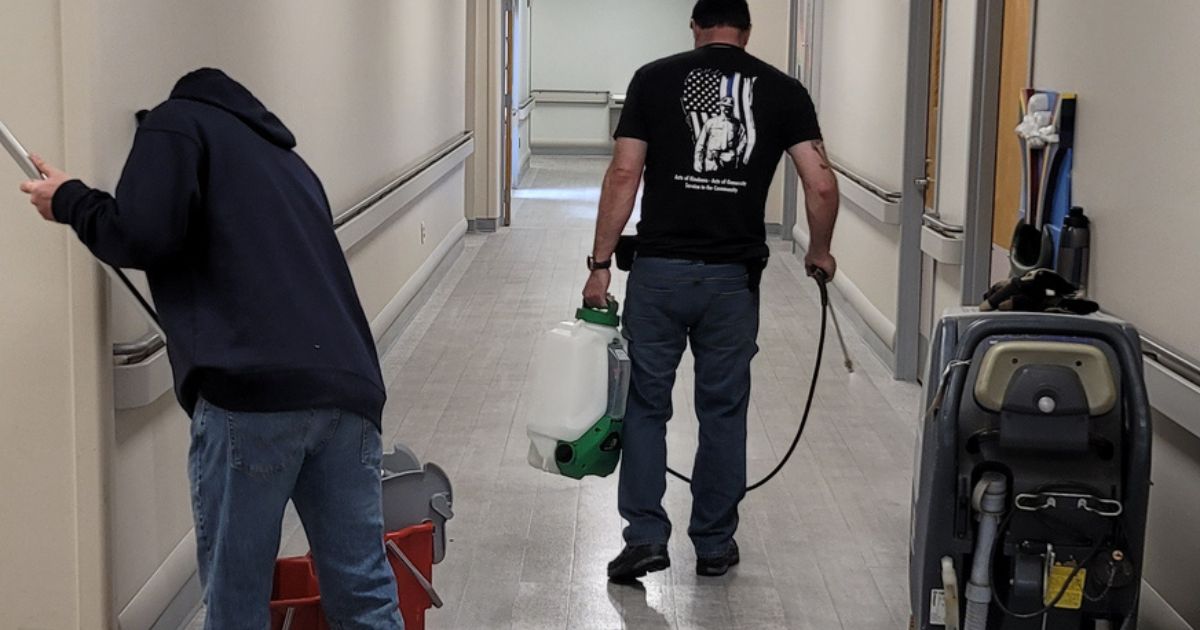
Commercial LVP floors cannot be refinished the way hardwood can. There is no sanding, no staining, no stripping and rewaxing. The wear layer on commercial LVP products is a factory-cured urethane coating that cannot be replenished once it degrades. When it is gone, it is gone. The practical maintenance strategy for commercial luxury vinyl plank flooring rests on three pillars: proper pH-neutral cleaning, protective care that respects the no-wax design, and modular plank replacement when damage goes too deep to clean away.
Quick reference:
- Traditional sanding and refinishing are not possible on LVP
- Use pH-neutral cleaners only; cleaning products should stay in the pH 7–9 range
- Never apply VCT strip-and-wax chemistry to LVP surfaces
- Replace damaged planks rather than attempting surface restoration
- Preventative care is the most cost-effective long-term strategy
The biggest misconception in commercial settings is treating LVP like vinyl composition tile. VCT requires a strip-and-wax maintenance cycle. LVP does not, and applying that same chemistry will void the warranty, cause permanent haze or etching, and accelerate the very surface failure you are trying to prevent.
Table of Contents
How to clean and protect commercial LVP floors every day
The foundation of LVP floor maintenance is consistent, gentle soil removal. Grit tracked in from outside acts like sandpaper under foot traffic, grinding micro-scratches into the wear layer with every step. Stop the grit before it reaches the floor and you have solved most of the problem.
Daily and routine cleaning:
- Dust mop or dry microfiber mop before any wet cleaning to lift abrasive particles
- Damp mop with a pH-neutral cleaner; never flood the floor, as excess moisture can undermine adhesive bonds at seams and edges
- Change the cleaning solution regularly to avoid redepositing soil
- Address spills immediately, particularly at seams where standing liquid creates adhesion problems over time
What to avoid:
- Steam mops, which force moisture into seams and can cause lifting
- Oil-based soaps, which leave residue that attracts more dirt
- Abrasive scrubbing pads or steel wool
- High-alkaline degreasers used as daily cleaners
- Any VCT stripper or wax product
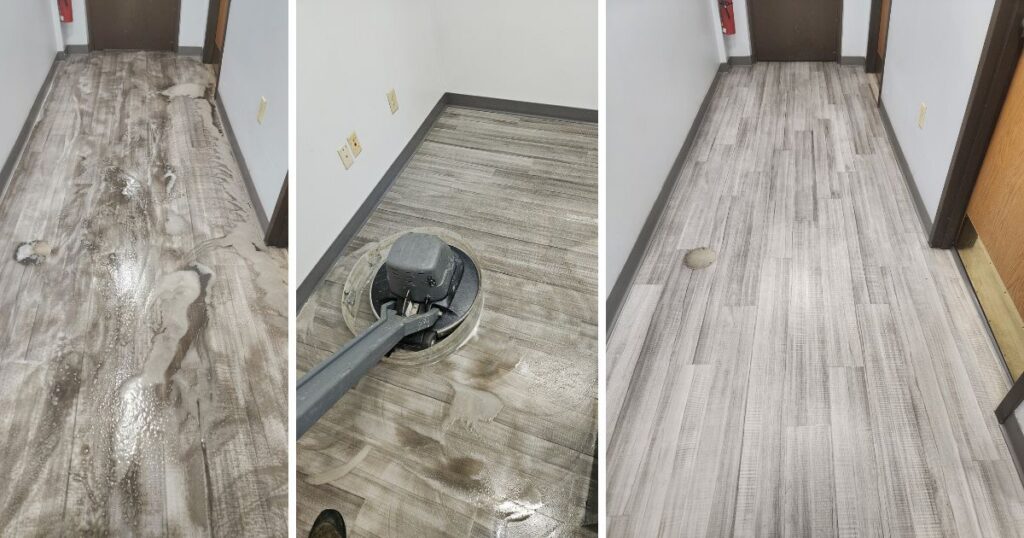
For periodic deep cleaning, an automatic floor scrubber with a soft pad and a neutral cleaner works well in high-traffic zones. Commercial floor care professionals typically run auto-scrubbers weekly or biweekly in heavy-use areas, then burnish as needed to restore gloss without adding chemistry.
Pro Tip: Before using any new cleaning or restorative product, check your LVP manufacturer’s approved product list. Some brands publish specific product names or ASTM standards their floors are tested against. Using an unapproved product, even one marketed as “vinyl safe,” can void your warranty and cause surface damage that looks like wear.
Professional maintenance programs for LVP rely on pH-neutral daily cleaning and periodic vinyl-specific restorer products for gloss refresh, deliberately avoiding wax and stripping cycles entirely.
Common commercial LVP repairs and when replacement is the right call
Surface damage that cannot be cleaned away falls into a few clear categories. Deep scratches that have penetrated through the wear layer into the print film below, burns, gouges, and staining that has absorbed into the material all require the same solution: plank replacement.
Common damage types requiring replacement:
- Deep scratches or gouges that expose the print layer
- Burns from cigarettes, equipment, or heat sources
- Permanent staining that survives cleaning attempts
- Planks with significant fading or discoloration from UV exposure or chemical damage
- Warped or bubbled planks from moisture intrusion
The repair process for floating LVP systems involves removing planks back to the nearest accessible expansion gap, pulling out the damaged units, and re-laying the field with matching material. Transition profiles are refitted at doorways and edges. For glue-down commercial installations, the process is more involved because adhesive bonds must be broken without damaging adjacent planks or the subfloor.
Matching replacement planks is the most common challenge. Dye-lot variation between production batches means planks purchased later may not match the original installation exactly, even from the same manufacturer and product line. UV fade on installed planks compounds the mismatch. Keeping a supply of original planks from the initial installation is the most reliable solution.
Minor surface scratches and scuffs can sometimes be minimized with a melamine eraser pad or a touch-up product from the flooring brand, but these are cosmetic fixes for light surface marks only. Anything that has broken through the wear layer needs a new plank.
Repair costs for isolated plank replacement typically range at affordable levels for DIY, while professional cleaning and polishing services generally cost less for cosmetic improvement. Full floor replacement has a higher cost range. When subfloor deflection exceeds L/360 limits, surface repairs are insufficient regardless of the floor type, and structural correction or full replacement becomes necessary.
Preventative maintenance that actually extends floor life
Reactive repairs cost more than prevention. Walk-off mats at every exterior entrance are the single highest-return investment in LVP floor longevity. Grit is the primary scratch source, and most of it enters through the first few feet of every doorway.
Preventative strategies that work:
- Install walk-off mats at all exterior entrances and high-traffic entry points
- Use felt glides under furniture legs and chair bases; rubber-backed furniture can stain LVP over time
- Dust mop daily, without exception, in high-traffic zones
- Never carry over VCT maintenance schedules or chemistry to LVP areas
- Apply manufacturer-approved low-maintenance refreshers only when the floor shows early signs of wear and only after confirming product compatibility
Avoiding the strip-and-wax cycle is not just a preference. Applying VCT finishes to no-wax LVP without verifying compatibility causes permanent haze and adhesion problems. Many facilities inherit this mistake from a previous maintenance contractor who treated all resilient flooring the same way.
Pro Tip: Walk the floor quarterly with a flashlight held at a low angle. Raking light reveals micro-scratch accumulation, dull traffic lanes, and early seam lifting that routine inspection misses. Catching these conditions early lets you schedule maintenance before damage becomes a replacement project.
Why professional LVP restoration services deliver better outcomes
Nu-England Services has been handling commercial floor cleaning and restoration in New England since 1968. That history matters in a category where the wrong product or technique causes permanent damage. Their approach to commercial LVP work follows manufacturer guidelines and uses eco-conscious chemistry, which protects both the floor and the facility’s indoor air quality.
Professional inspection catches problems that in-house maintenance misses: subfloor moisture readings, seam integrity issues, early wear-layer degradation in traffic lanes, and adhesion failures at edges. Addressing these early, through targeted cleaning, compatible refresher applications, or isolated plank replacement, consistently costs less than waiting until the damage spreads.
Pro Tip: When hiring a commercial floor service provider, ask specifically whether they distinguish between LVP and VCT maintenance protocols. A contractor who treats them the same is a liability, not an asset.
What refinishing LVP floors actually cannot do
The word “refinishing” carries a specific meaning for LVP: it does not apply the way it does to hardwood. Sanding is off the table entirely. The wear layer is synthetic urethane, not wood, and removing material exposes the decorative print film underneath, destroying the plank. Buffing with abrasive pads risks the same outcome and may void the warranty.
Topcoats and sealers marketed for vinyl can provide a temporary gloss improvement, but they do not repair wear, restore faded color, or replace the factory finish. Paint applied over LVP chips and peels quickly under commercial foot traffic. Most major manufacturers explicitly discourage these alterations. The LVP wear layer is not replenishable once damaged, which is the fundamental constraint that shapes every maintenance and repair decision.
Step-by-step: the commercial LVP restoration process
What professionals actually do when a commercial LVP floor needs attention follows a clear sequence, even if it does not look like traditional refinishing.
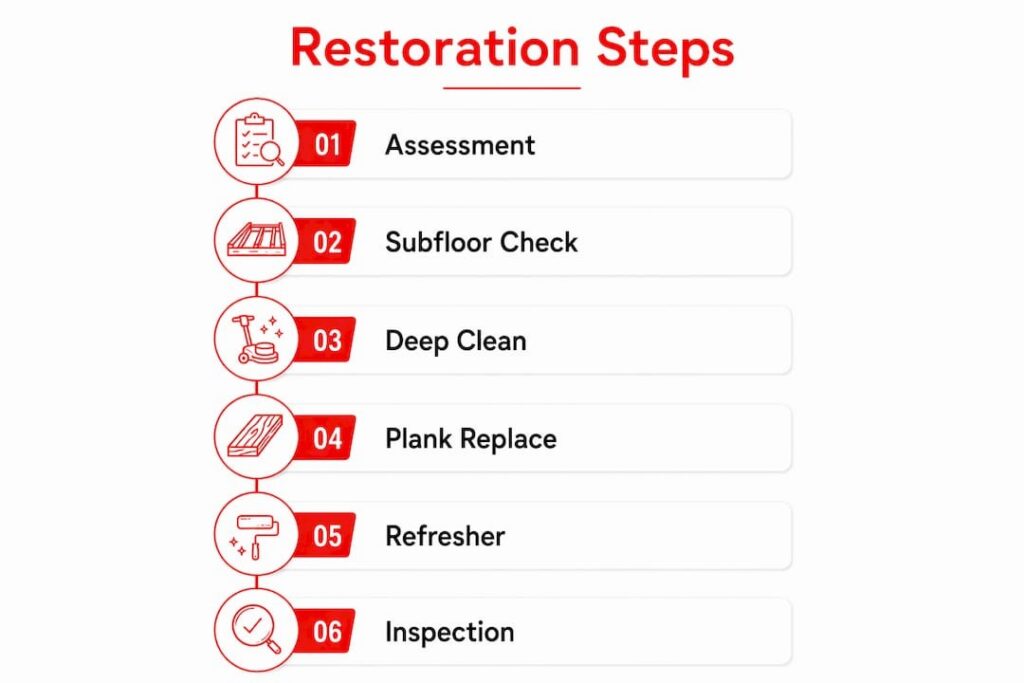
- Condition assessment. Inspect the entire floor under raking light. Document damage zones, traffic lane wear, seam conditions, and any areas of lifting or moisture intrusion. Moisture meter readings are standard practice before any repair work begins.
- Subfloor evaluation. Check for deflection, soft spots, or moisture vapor issues. Any peak-to-valley deviation exceeding 3/16 inch over a 10-foot span, per RFCI standards, can cause joint failure in floating LVP and must be corrected before new planks go down.
- Deep cleaning. Run an auto-scrubber with a compatible soft pad and neutral cleaner across the full field. This removes embedded soil and prepares the surface for accurate damage assessment.
- Plank replacement. Remove damaged planks back to the nearest expansion gap. Install matching replacement planks and refit transition profiles. For glue-down systems, use the manufacturer-specified adhesive and allow full cure time before reopening to traffic.
- Refresher application (if warranted). If the floor shows early gloss loss but the wear layer is intact, a manufacturer-approved vinyl restorer can be applied according to product instructions. This is a cosmetic step, not a structural repair.
- Post-service inspection. Verify adhesion, seam integrity, and surface planarity. In commercial settings subject to OSHA’s Walking-Working Surfaces standard (29 CFR 1910.22), delaminated edges or lifted joints create a compliance obligation independent of aesthetics.
How to assess whether your LVP floor is a candidate for restoration
Not every worn LVP floor needs replacement. The assessment comes down to where the damage sits in the floor’s layer structure.
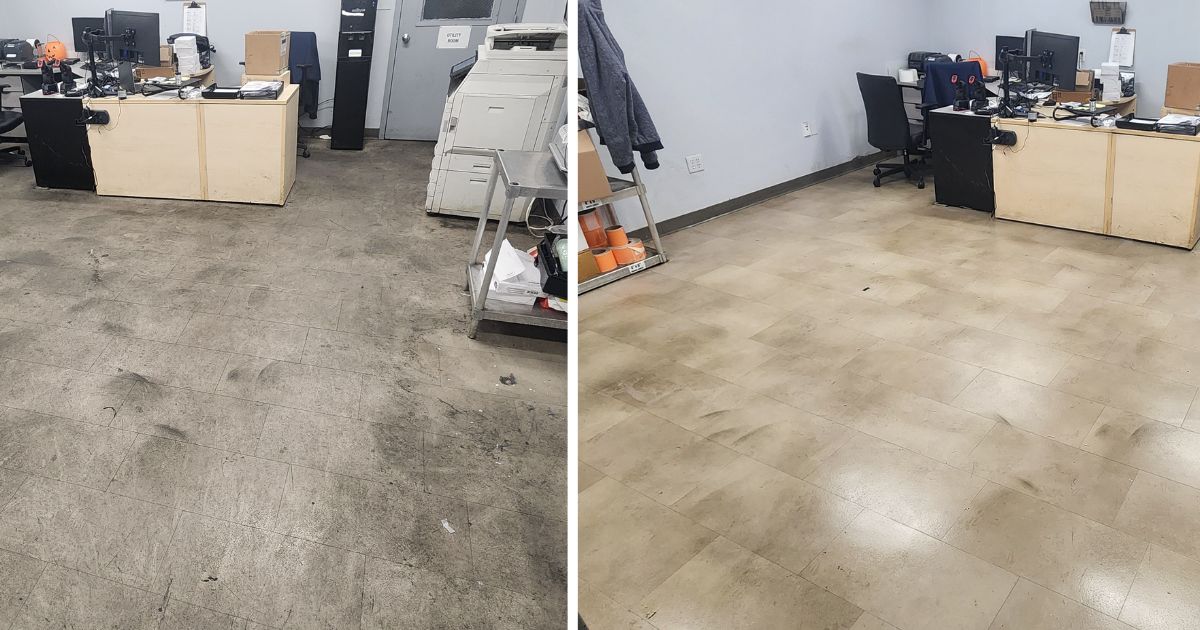
Surface-level wear shows as dullness, light scuffing, or minor scratches that have not broken through the wear layer. A deep clean with an approved vinyl cleaner often restores the appearance. A compatible restorer product can help if the floor is uniformly dull.
Wear-layer penetration is visible as scratches that catch a fingernail, color loss in the scratch channel, or a texture change in the damaged area. Once the print film is exposed, cleaning and restorers cannot fix it. Plank replacement is the only real solution.
Structural damage includes warping, bubbling, edge lifting, or planks that flex underfoot. These indicate subfloor or adhesive problems that surface treatment cannot address. Repair scope expands to include subfloor correction before new flooring goes down.
The repair-versus-replacement threshold in commercial flooring practice generally favors repair when damage covers a small portion of the floor area and matching material is available. Beyond a substantial extent of coverage, full replacement typically delivers better lifecycle value.
Professional service versus DIY: how to decide
DIY plank replacement is realistic for floating LVP systems when matching material is available and the damage is isolated to a small area. The click-lock mechanism on most commercial LVP makes individual plank removal and reinstallation straightforward with basic tools.
Professional service makes more sense when the damage involves glue-down installations, subfloor issues, moisture problems, or when the affected area is large enough that mismatched planks will be visible. Professionals also carry moisture meters, subfloor leveling compounds, and manufacturer-specific product knowledge that changes the outcome on complex repairs.
For routine maintenance, in-house staff can handle daily dust mopping and damp mopping with the right products. Periodic deep cleaning, refresher applications, and any repair work beyond surface-level scuffs are worth contracting to a commercial floor services provider with documented LVP experience.
Safety and environmental considerations during LVP restoration
Commercial LVP restoration work involves fewer hazardous materials than hardwood refinishing, but several precautions still apply. Stripping products, even when used correctly on LVP, release fumes that require ventilation. Any adhesive used in glue-down plank replacement should be low-VOC and appropriate for the facility type, particularly in healthcare or food service environments.
OSHA’s 29 CFR 1910.22 requires that commercial floor surfaces be maintained free of tripping, slipping, and falling hazards. Lifted seams, delaminated edges, or planks that flex underfoot trigger a compliance obligation. Scheduling repairs promptly when these conditions appear is not just good practice; it is a legal requirement in commercial occupancies.
Eco-conscious facilities should look for cleaning solutions that are biodegradable, phosphate-free, and certified for use in occupied commercial spaces. Many manufacturer-approved LVP cleaners meet these criteria and are safer for both staff and building occupants than general-purpose industrial cleaners.
Post-restoration care: keeping the floor in good condition
After a deep cleaning or plank replacement, the floor needs a structured maintenance plan to protect the work done. For the first 24–48 hours after plank replacement in glue-down systems, limit foot traffic to allow the adhesive to cure fully. Wet mopping should be avoided for the first seven days after any new LVP installation, per standard manufacturer guidance.
Once the floor is back in service, return to the daily dust mop and damp mop routine immediately. Entrance matting should be checked and cleaned regularly; a dirty mat deposits grit rather than capturing it. Inspect seams and edges monthly in high-traffic zones. Apply a manufacturer-approved refresher only when the floor shows visible gloss loss, not on a fixed schedule.
Mistakes that damage LVP floors during maintenance and repair
The most expensive mistakes in commercial LVP care are almost always chemistry mistakes. Using a VCT stripper, a high-alkaline degreaser, or an unapproved shine product causes damage that looks like wear but is actually chemical etching. By the time it is visible, the wear layer is compromised.
Common mistakes to avoid:
- Skipping dust mopping before wet cleaning, which turns grit into an abrasive slurry
- Over-wetting the floor, which causes seam and edge problems over time
- Applying VCT finish to LVP without confirming manufacturer compatibility
- Using aggressive pads or brushes on LVP surfaces
- Ignoring entrance matting, which is where most damage originates
- Attempting to sand, buff aggressively, or chemically strip LVP as you would hardwood
- Assuming all resilient flooring responds to the same maintenance chemistry
One overlooked mistake: buying replacement planks from a different production batch without checking the dye lot. Even the same SKU from the same manufacturer can look noticeably different if the batch does not match, and UV fade on the installed floor widens that gap further.
NES, Co. brings 55+ years of commercial floor expertise to your facility
Keeping a commercial LVP floor looking sharp year after year takes more than a mop and a bucket. It takes the right chemistry, the right schedule, and someone who knows the difference between a floor that needs cleaning and one that needs a plank pulled.
NES, Co., the operating name for Nu-England Services, has been handling commercial cleaning and flooring restoration across New England since 1968. For property managers who want a single provider that understands LVP maintenance protocols, uses eco-conscious products, and can handle everything from routine floor care to isolated plank replacement, NES, Co. is a direct fit. The team follows manufacturer guidelines, which protects your warranty and your floor investment simultaneously.
Request a quote for commercial floor care and get a transparent assessment of what your LVP floors actually need, without upselling services they do not require.
Key Takeaways
Commercial LVP floors require pH-neutral cleaning, preventative grit control, and modular plank replacement rather than traditional refinishing, which is not possible due to the factory-cured wear layer.
|
Point |
Details |
|
Refinishing is not possible |
LVP’s factory urethane wear layer cannot be sanded or restored once damaged. |
|
Plank replacement costs |
Repair costs for isolated plank replacement typically range at affordable levels for DIY. |
|
VCT chemistry causes damage |
Applying strip-and-wax products to LVP voids warranties and causes permanent haze or etching. |
|
Prevention beats repair |
Daily dust mopping and entrance matting reduce micro-scratch buildup, delaying costly plank replacement. |
|
NES, Co. for commercial LVP care |
NES, Co. provides manufacturer-compliant LVP cleaning, restoration, and plank replacement services across New England. |
Recommended
